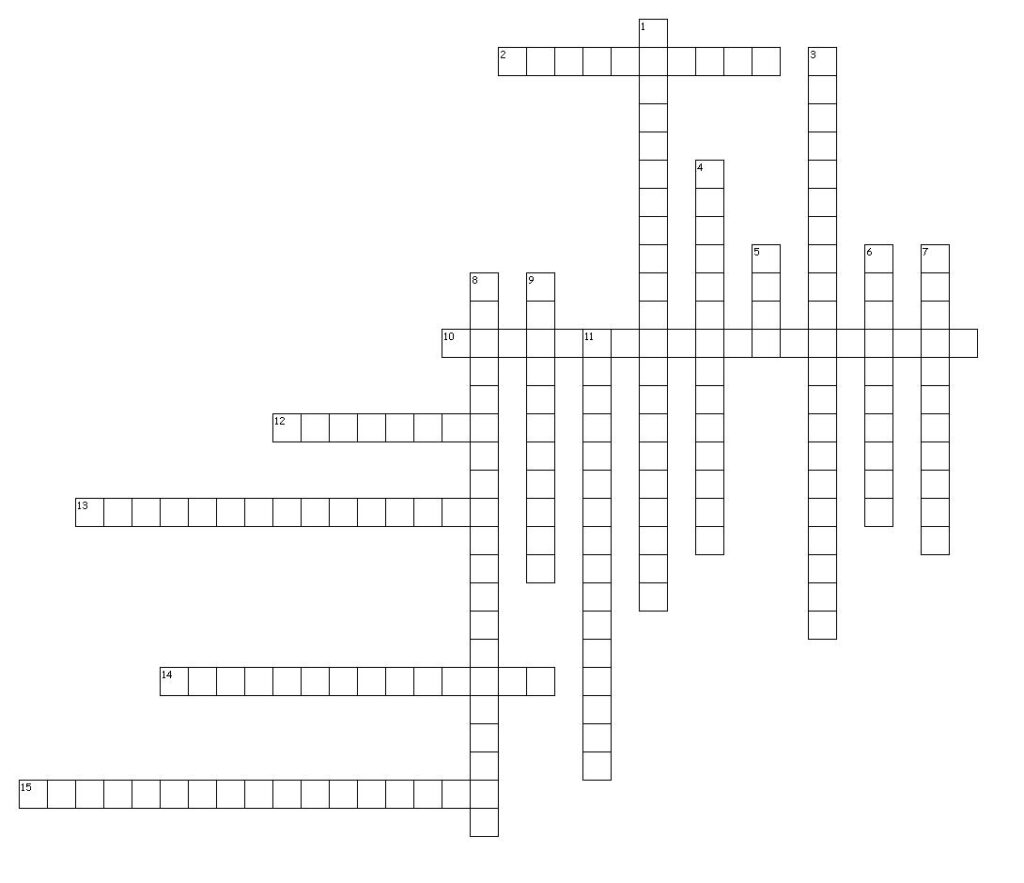
Across
2. In cellular respiration, series of anaerobic chemical reactions in the cytoplasm that break down glucose into pyruvic acid; forms a net profit of two ATP molecules.
10. Chemical process where mitochondria break down food molecules to produce ATP; the three stages are glycolysis, the citric acid cycle, and the electron transport chain.
12. Molecules that absorb specific wavelength of sunlight.
13. In cellular respiration, series of reactions that break down glucose and produce ATP; energizes electron carriers that pass energized electrons on to the electron transport chain.
14. Process by which autotrophs, such as algae and plants, trap energy from sunlight with chlorophyll and us this energy to convert carbon dioxide and water into simple sugars.
15. Series of proteins embedded in a membrane along which energized electrons are transported; as electrons are passed from molecule to molecule, energy is released.
Down
1. Anaerobic process where cells convert pyruvic acid into carbon dioxide and ethyl alcohol; carried out by many bacteria and fungi such as yeast.
3. Energy-storing molecule in cells composed of an adensosine molecule, a ribose sugar and three phoshate groups; energy is stored in the molecules’s chemical bonds and can be used quickly and easily by cells.
4. Phase of photosynthesis where light energy is converted to chemical energy in the form of ATP; results in the splitting of water and the release of oxygen.
5. Electron carrier molecule; when carrying excited electrons, it becomes NADPH.
6. Reaction taking place in the thylakoid membranes of a chloroplast during the light-dependent reactions where two molecules of water are split to form oxygen, hydrogen ions, and electrons.
7. Light-absorbing pigment in plants and some protists that is required for photosynthesis; absorbs most wavelengths of light except green.
8. Molecule formed from the breaking off of a phosphate group from ATP; results in a large release of energy that is used for biological reactions.
9. Series of reactions during the light-independent phase of photosynthesis in which simple sugars are formed from carbon dioxide using ATP and hydrogen from the light-dependent reactions.
11. Phase of photosynthesis where energy from light-dependent reactions is used to produce glucose and additional ATP molecules.